

Austin, TX, December 3, 2025
Astronomers have made a significant breakthrough by observing supernova SN 2024ggi, which exhibits an elongated shape, contrary to previous spherical models. Detected on April 10, 2024, in the galaxy NGC 3621, this discovery has important implications for our understanding of stellar explosions and their evolution. The Very Large Telescope (VLT) captured critical data just 26 hours after detection, prompting further inquiries into the mechanisms behind such cosmic events. This landmark finding encourages continued investment in astronomical research.
Austin, TX
Discovering the Unconventional Shape of a Supernova
Astronomers have made a landmark discovery in the field of astrophysics by observing a supernova explosion that defies traditional expectations, presenting an elongated form rather than a spherical one.
This achievement traces back to an exciting moment on April 10, 2024, when the ATLAS observatory first detected the supernova known as SN 2024ggi. Located 22 million light-years away in the galaxy NGC 3621, nestled within the constellation Hydra, the incident quickly attracted attention. Utilizing cutting-edge technology from the Very Large Telescope (VLT) in Chile, astronomers gathered critical spectropolarimetry data just 26 hours post-detection, revealing the unusual shape of the explosion.
The observation of SN 2024ggi challenges long-held beliefs about supernova shapes, which were previously thought to be uniform. This nuanced understanding not only enhances our knowledge of stellar explosions but also fosters greater dialogue and inquiry into the nature of the universe, underscoring the importance of sustained investment in astronomical research.
Understanding Supernova Explosions
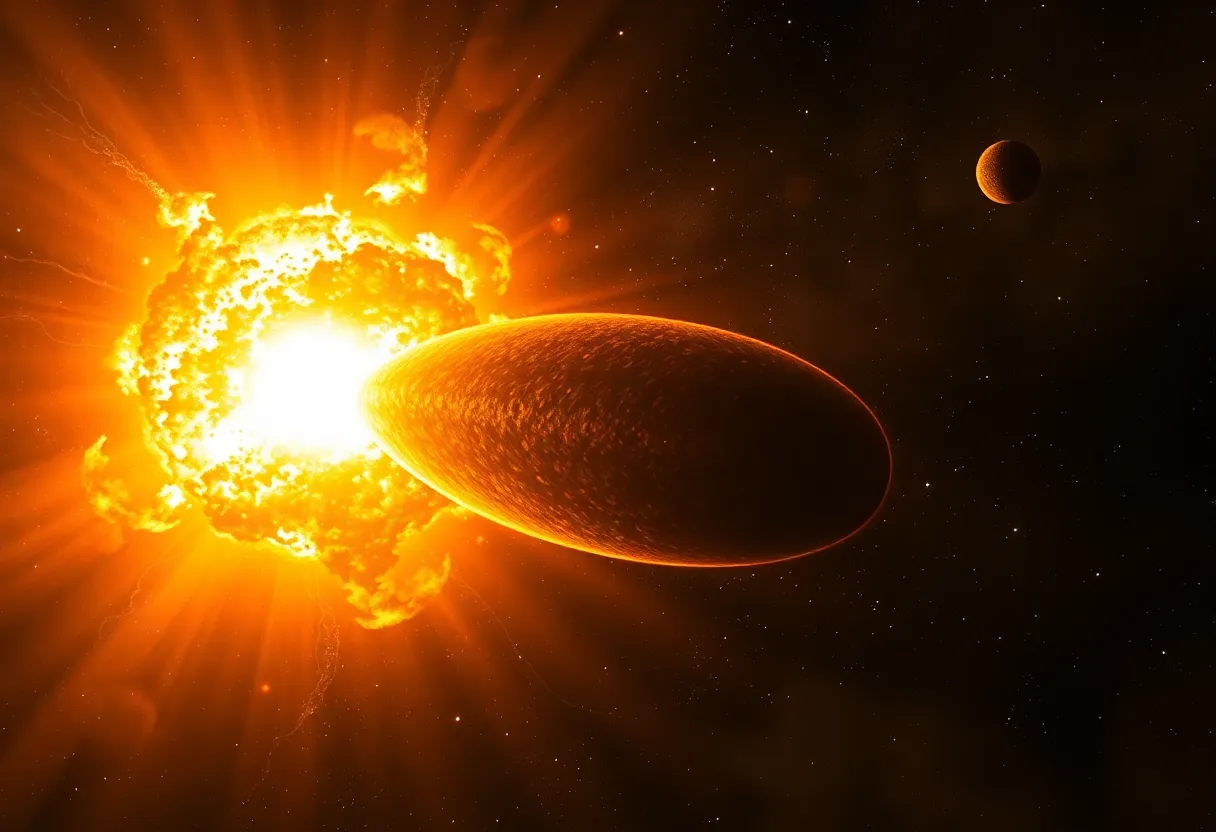
Supernovae mark the explosive deaths of massive stars, and until now, the prevailing notion suggested these events occurred in spherical forms. The case of SN 2024ggi, however, adds a new dimension to our understanding. The VLT’s observations indicated a distinct elongation along one axis, resembling an olive. This revelation invites scientists to reconsider existing models of supernova blasts, proposing that perhaps there is a regular, directional mechanism responsible for such explosions.
Implications for Stellar Evolution Studies
With the unique data from SN 2024ggi in hand, researchers are now equipped to delve deeper into the processes surrounding the demise of massive stars. The recent findings encourage further explorations into how these extraordinary cosmic events develop and unfold. By identifying and analyzing the mechanisms behind the initial explosion, scientists can better piece together the puzzle of stellar evolution and contribute to a broader dialogue about our universe’s ongoing narrative.
Background on Supernova Observations
Supernovae rank among the most energetic occurrences in the cosmos, offering insight into stellar life cycles and the formation of heavy elements. While many studies have concentrated on the aftermath of these spectacular events, examining early phases has typically been fraught with challenges. Fortunately, advancements in technology such as the VLT’s FORS2 instrument enable astronomers to closely monitor and document these pivotal moments, yielding groundbreaking discoveries about the phenomena at play.
Conclusion
The observation of SN 2024ggi’s distinctive explosion shape heralds a significant step forward for astrophysics. Not only does it rectify pre-existing models of supernovae, but it serves as a catalyst for future inquiries that promise to enhance our understanding of cosmic evolution. It stands as a testament to the necessity of continued investment in scientific research and innovation, which fuels both curiosity and industry growth.
FAQ
What is SN 2024ggi?
SN 2024ggi is a supernova explosion observed in galaxy NGC 3621, located 22 million light-years away in the constellation Hydra. It was first detected on April 10, 2024, by the ATLAS observatory.
How was the unique shape of the supernova observed?
Astronomers used the Very Large Telescope (VLT) in Chile to capture spectropolarimetry data just 26 hours after the supernova was first detected, revealing its elongated shape resembling an olive.
What does this discovery mean for our understanding of supernovae?
This discovery challenges existing models of supernova explosions, suggesting a consistent, directional mechanism behind the blast and offering new insights into the physical processes during the death of massive stars.
Why is observing the early stages of supernovae important?
Observing the early stages of supernovae allows astronomers to gain insights into the mechanisms driving these explosions and the behavior of massive stars in their final moments, contributing to our broader understanding of stellar evolution.
Key Features of the Discovery
| Feature | Description |
|---|---|
| Supernova Designation | SN 2024ggi |
| Location | Galaxy NGC 3621, 22 million light-years away in the constellation Hydra |
| Detection Date | April 10, 2024 |
| Observing Instrument | Very Large Telescope (VLT) in Chile |
| Unique Observation | Elongated explosion shape resembling an olive, observed 26 hours after detection |
| Publication Date | November 12, 2025 |
Deeper Dive: News & Info About This Topic
HERE Resources