

News Summary
Texas has officially mandated that all public school classrooms display the Ten Commandments as part of a new law signed by Governor Greg Abbott. This requirement, aimed to promote religious values, faces potential legal challenges over concerns regarding the separation of church and state. The law, which received bipartisan support, stipulates that each classroom must have a ‘durable poster or framed copy’ of the commandments. Critics fear the law may marginalize students from diverse religious backgrounds, raising questions about its implementation and the inclusive nature of Texas’ educational system.
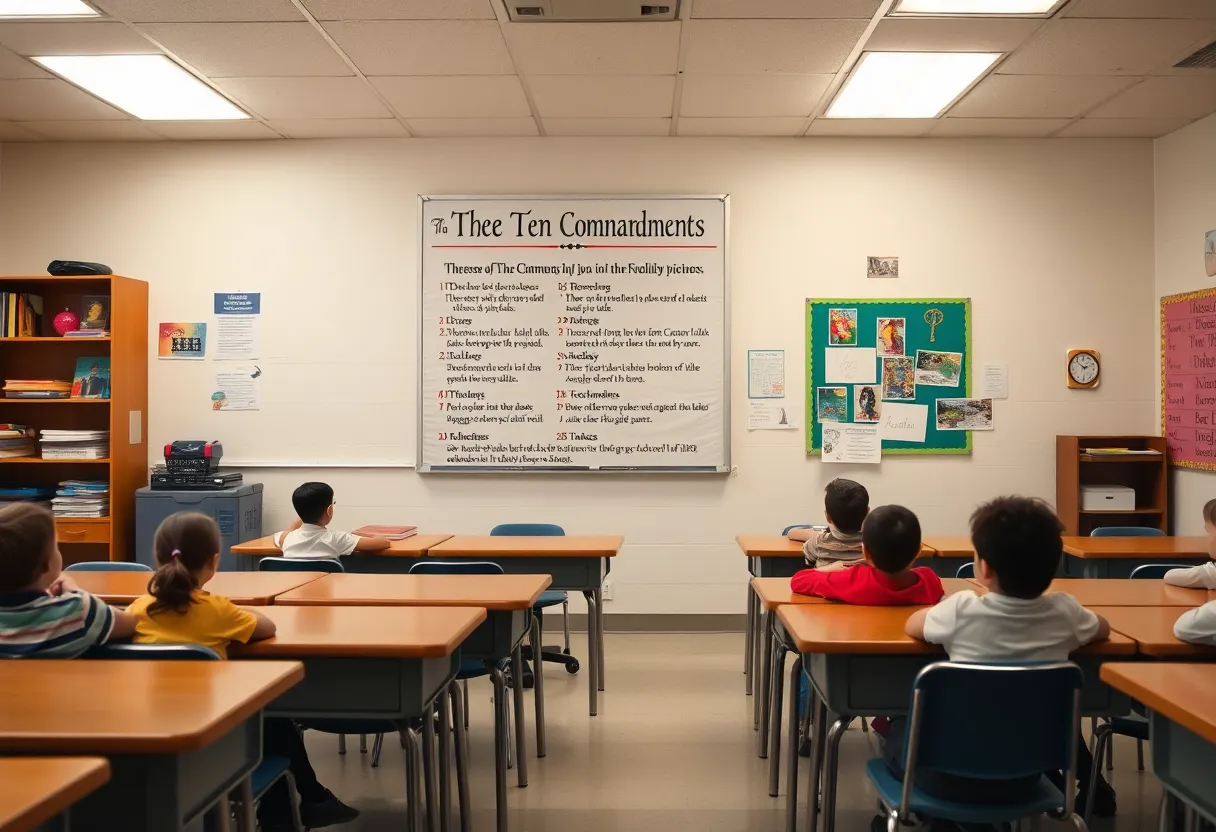
Austin, Texas – Texas has officially mandated that all public school classrooms must display the Ten Commandments, a move that marks the state as the largest to adopt such a requirement. The law, signed by Governor Greg Abbott, stipulates that a “durable poster or framed copy” of the Ten Commandments be displayed in each classroom with specific size requirements of at least 16 inches wide and 20 inches tall. This initiative, endorsed during the recent legislative session, is anticipated to experience legal challenges based on concerns surrounding the separation of church and state.
The legislative approval was largely secured in a Republican-dominated environment, as both the state House and Senate passed the mandate during their session, which ended on June 2. The proposal received backing from several legislators, including its co-sponsor, who emphasized the significance of the Ten Commandments within the American educational and judicial framework. In conjunction with this law, Abbott also enacted another bill that permits schools to provide students and staff with a daily voluntary period for prayer or the reading of religious texts.
Supporters of this legislation argue that the Ten Commandments serve as a crucial foundation for the U.S. judicial and educational systems. However, not all viewpoints align with this perspective. Various religious leaders and advocacy groups have expressed deep concerns, calling the law unconstitutional and an infringement on religious liberties, especially in a state known for its diverse student population of approximately 6 million spread across 9,100 public schools.
Legal experts predict that the law will face hurdles in court similar to those encountered in other states. For instance, a recently implemented law in Louisiana was blocked by a federal court due to its failure to align with constitutional standards, while a law enacted in Arkansas is also under active legal scrutiny. The concerns primarily revolve around the potential violation of the principle of separation of church and state, a concern that has been pivotal in past legal battles regarding religious expressions in public schools.
In the context of Texas, the new regulation does not outline enforcement mechanisms or penalties should schools or teachers fail to comply. Additionally, the law does not establish a criminal offense for non-adherence, which could lead to questions about its practical implications in the classroom setting. An amendment proposed in the House to allow for displays in various languages or to provide opt-in options for school districts was also dismissed, raising further concerns about inclusivity and potential alienation of students from diverse religious backgrounds.
Critics of the legislation warn that it may foster environments that enable exclusion or bullying for students who do not identify with Christian beliefs, posing a risk to the well-being of many in the state’s educational system. Observers note that this law is part of a broader ideological movement seen in several conservative-led states aiming to integrate religious texts into public education, drawing attention to growing concerns about the implications for students from diverse faiths.
The law’s proponents, on the other hand, see it as a reflection of the historical significance attributed to the Ten Commandments and their role in shaping the country’s legal landscape. This debate continues to unfold as various stakeholders, including educators, parents, and students, weigh the impacts of this law on Texas’ educational framework. With the enactment of this legislation, Texas steps into a contentious chapter in the ongoing dialogue over the intersection of religion, education, and constitutional rights.
Deeper Dive: News & Info About This Topic
HERE Resources
Texas Governor Signs Law to Display Ten Commandments in Schools
University of Texas at Austin Ranks Among Top Universities
Texas Schools Mandate Display of Ten Commandments
Lawsuit Against Ten Commandments Display in Louisiana Schools Ends in Unconstitutional Ruling
Texas House Takes Bold Step to Ban All THC Products
Texas Population Surge Influences School District Selection
Texas Legislative Session Wraps Up with Key Business Legislation
Austin Faces Severe Weather as Power Restored After Storms
Texas Senate Advances Bill for Ten Commandments in Classrooms
Texas Legislature Passes Bill Mandating Ten Commandments in Classrooms
Additional Resources