

News Summary
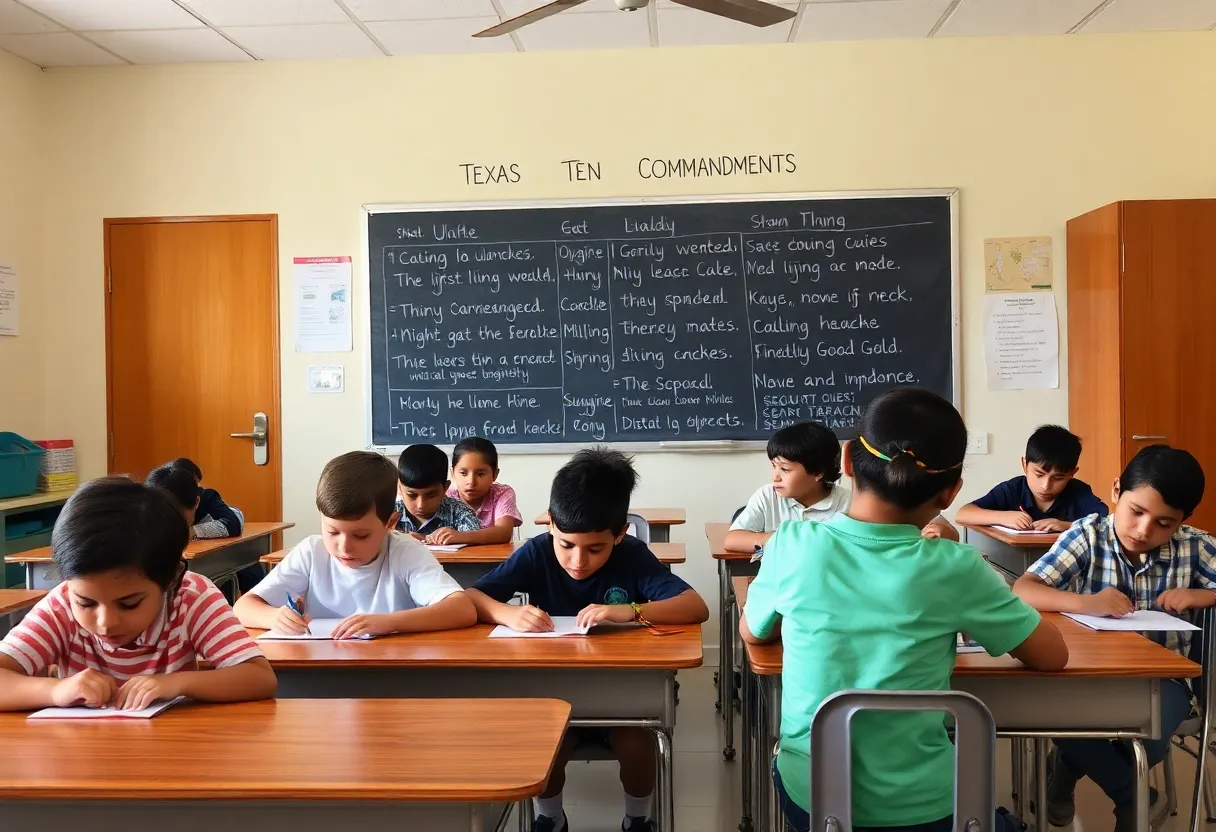
The Texas Legislature has approved Senate Bill 10, requiring public schools to display the Ten Commandments in classrooms. While supporters assert it provides a moral foundation, notable opposition has arisen from civil rights groups, such as the ACLU, who argue this infringes on constitutional rights, specifically the First Amendment. Legal battles are anticipated as concerns grow over the implications of enforcing religious displays in educational settings. The bill’s requirements, including the specified Protestant translation, have drawn criticism from various faith leaders, highlighting the potential impact on religious pluralism in Texas schools.
Austin, Texas — The Texas Legislature has passed Senate Bill 10, which mandates that public schools in the state display the Ten Commandments in each classroom. The measure, which was approved by the Texas House of Representatives on May 25, 2025, and subsequently agreed upon by the Texas Senate on May 28, is now awaiting the signature of Governor Greg Abbott, who has indicated his intention to support the legislation.
SB 10 has generated significant opposition from civil rights organizations, including the American Civil Liberties Union (ACLU), which plans to challenge the bill’s legality. The ACLU, along with other groups such as Americans United for Separation of Church and State and the Freedom From Religion Foundation, is poised to contest the provision on constitutional grounds. They argue that the requirement to display the Ten Commandments in public schools infringes on the First Amendment’s Establishment Clause, which prohibits the government from promoting one religion over another.
One key feature of SB 10 is that it stipulates legal disputes concerning the bill’s enforcement will be handled by the state rather than individual school districts. Proponents of the bill, including its author Senator Phil King, believe that the legislation is supported by a precedent set by the recent U.S. Supreme Court ruling in Kennedy v. Bremerton School District, which they perceive as a validation of similar religious expressions in public settings.
Despite the stated intentions of the bill’s supporters, legal experts and opponents highlight the differences in relevant cases, pointing to the Supreme Court’s earlier ruling in Stone v. Graham, which challenges the constitutionality of displaying religious texts in government-funded institutions. ACLU staff attorney Chloe Kempf has raised concerns about the implications of using public spaces to convey religious messages, reinforcing the viewpoint that education should remain secular.
The bill further stipulates that the Ten Commandments must be displayed using a specified Protestant translation. This aspect has raised additional criticisms, particularly from over 166 Texas faith leaders who argue that such a requirement may not accurately represent the beliefs of all students, thereby undermining religious pluralism in public education.
SB 10 is regarded as one of the most extensive measures of its kind in the United States, potentially affecting over 5 million students across approximately 9,000 public schools in Texas. Supporters argue that acknowledging the Ten Commandments has historical and cultural significance, asserting that these teachings can serve as a moral foundation for students.
Notably, the Texas Legislature is nearing the end of its session, which has heightened the focus on SB 10, particularly following the failure of a similar bill in the previous session. The law also permits school districts to utilize either local funding or accept donations to cover the costs associated with displaying the Ten Commandments.
In contrast to Texas, a similar law initiated in Louisiana was previously blocked by a U.S. District Court ruling and is currently under review by the Fifth Circuit Court of Appeals, illustrating a national landscape where such legislative actions are under scrutiny.
As the debate surrounding SB 10 continues, the potential legal battle ahead could set a significant precedent that influences the future of religious expression in public education across the United States. Opponents of the bill remain adamant in their pursuit to uphold the principles of constitutional law and protect the rights of students and families to determine their own religious beliefs without state influence.
Deeper Dive: News & Info About This Topic
HERE Resources
Texas Bill Mandates Display of Ten Commandments in Schools
Austin, Texas Faces Unseasonably Warm Weather This Week
Severe Weather Alerts Issued for Central Texas
Texas House Approves Display of Ten Commandments in Classrooms
Central Texas Faces Severe Weather and Key Legislation Updates
Texas Bill Requires Display of Ten Commandments in Schools
Texas House Approves Daily Prayer Proposal in Schools
New Bills Spark Debate on Religion in Schools
Shift Towards Religious Education Sparks Controversy in American Schools
Texas Approves Bible-Infused Curriculum for Elementary Schools, Sparking Controversy Over Religion in Education
Additional Resources
- Fox 7 Austin
- Wikipedia: Establishment Clause
- KXAN
- Google Search: Ten Commandments Texas public schools
- Washington Post
- Google Scholar: Ten Commandments public schools case
- CBS News
- Encyclopedia Britannica: Separation of church and state
- NBC DFW
- Google News: Texas Ten Commandments lawsuit
- Los Angeles Times