

News Summary
Residents in northern Texas can look forward to a unique opportunity to witness the aurora borealis this evening as a strong G4 geomagnetic storm is expected. This event marks one of the strongest storms since early May, with visibility reaching the Panhandle area and potentially extending to southern regions. The storm is driven by a coronal mass ejection and is anticipated to last into the early hours of June 2. Observers are encouraged to find darker locations away from urban light pollution to enjoy this natural light display.
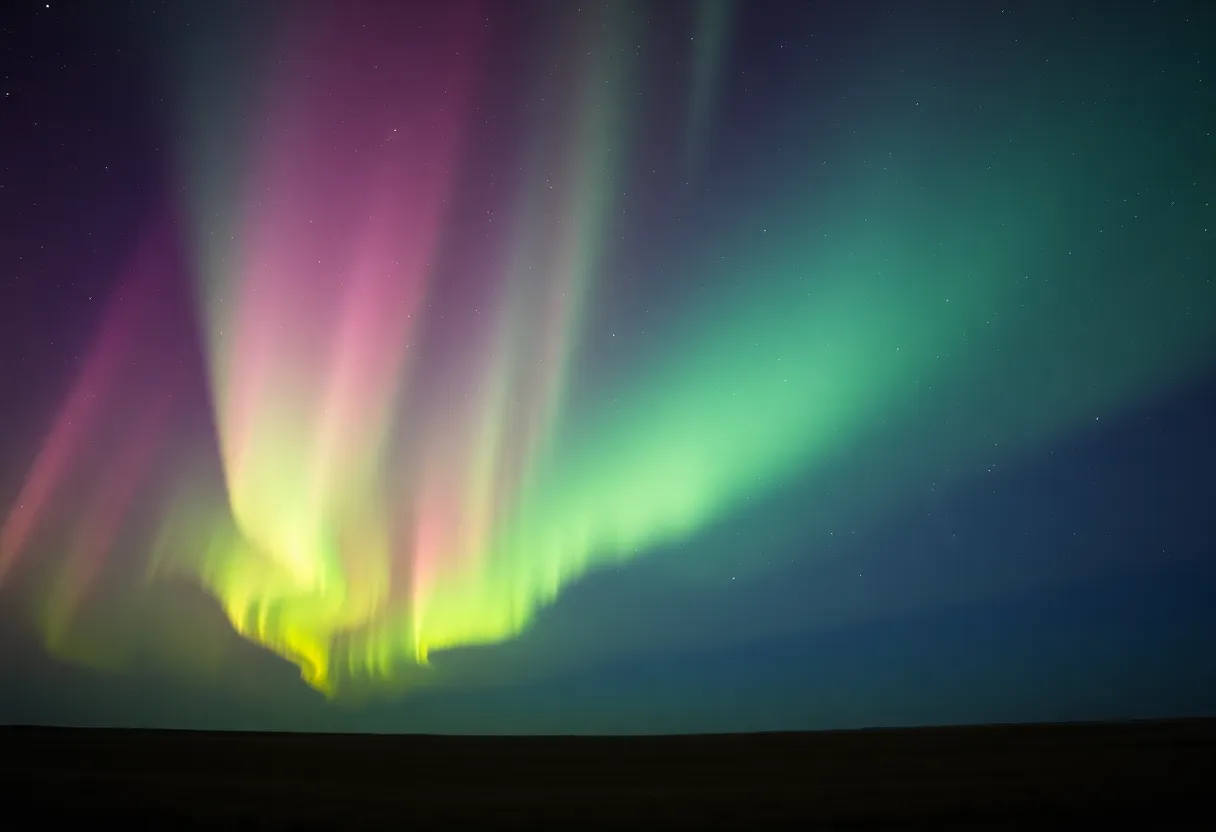
Amarillo, Texas – Residents in northern Texas are in for a rare celestial treat this evening as a severe geomagnetic storm classified as G4 is forecasted to illuminate the night sky with the aurora borealis. This event is one of the strongest geomagnetic storms recorded since early May 2024, allowing visibility of the auroras to the naked eye, particularly in the Panhandle area north of Amarillo. Observers in southern regions such as Austin-San Antonio, and possibly Houston, may still catch glimpses of the auroras using cameras or smartphones.
The geomagnetic storm is expected to persist into the early hours of June 2, as per data from the National Oceanic and Atmospheric Administration’s (NOAA) Space Weather Prediction Center. This storm is driven by a coronal mass ejection (CME) that struck Earth during the early hours of June 1, combined with high-speed solar winds emanating from coronal holes.
Adding to the excitement, another CME is predicted to arrive late on June 2, prolonging the storm’s effects, with a smaller CME predicted for June 3-4. The storm associated with the June 1 event was traveling at approximately 1,938 kilometers per second (about 4.3 million mph) and resulted from a complex interaction of materials from various CMEs.
The auroras occur when electrically charged particles from space collide with Earth’s atmosphere, creating vibrant displays of color through molecular collisions. However, visibility may be limited, and auroras can be quite unpredictable, as the ideal conditions must align for optimal viewing opportunities.
The best time to observe the aurora will typically fall between 10:00 p.m. and 2:00 a.m. local time, although this window may expand as geomagnetic activity increases. Those hoping to see the auroras are encouraged to move away from urban light pollution and find darker areas for better viewing conditions.
The aurora forecast indicates potential sightings can extend as far south as the Austin-San Antonio region. Historically, during exceptionally strong geomagnetic events, auroras have been observed as far south as Mexico City.
Aside from the stunning visuals, this geomagnetic storm could also create minor disruptions to technology and electronic communications, particularly affecting GPS and satellite signals. Earth’s magnetic field typically shields it from solar winds, a barrier that is crucial for the occurrence of auroras.
This solar activity aligns with the sun’s approach towards the solar maximum, a phase marked by increased sunspots and solar flares. Space weather physicists indicate that the current situation could evolve, given the interaction of multiple CMEs which may present more than one “core” signature.
Local community members are encouraged to document and share their aurora sightings with photos and videos, contributing to a community endeavor to capture the excitement of this rare phenomenon. For real-time updates and information on aurora visibility, NOAA has made an aurora dashboard available to the public.
As this geomagnetic storm unfolds, residents across Texas are invited to engage with the sky, witnessing a remarkable event that highlights the dynamic interaction between the Earth and solar activity. Enthusiasts are advised to prepare accordingly and enjoy this extraordinary chance to see nature’s light show directly from their backyards.
Deeper Dive: News & Info About This Topic
HERE Resources
Get Ready for a Celestial Show: Northern Lights Expected Tonight!
Texas Launches Commercial Self-Driving Truck Service
Additional Resources
- Austin American-Statesman
- Wikipedia: Aurora
- Live Now Fox News
- Google Search: Aurora Borealis
- Fox Weather
- Google Scholar: Aurora Borealis
- NBC News
- Encyclopedia Britannica: Aurora
- NBC DFW
- Google News: Aurora Borealis