

News Summary
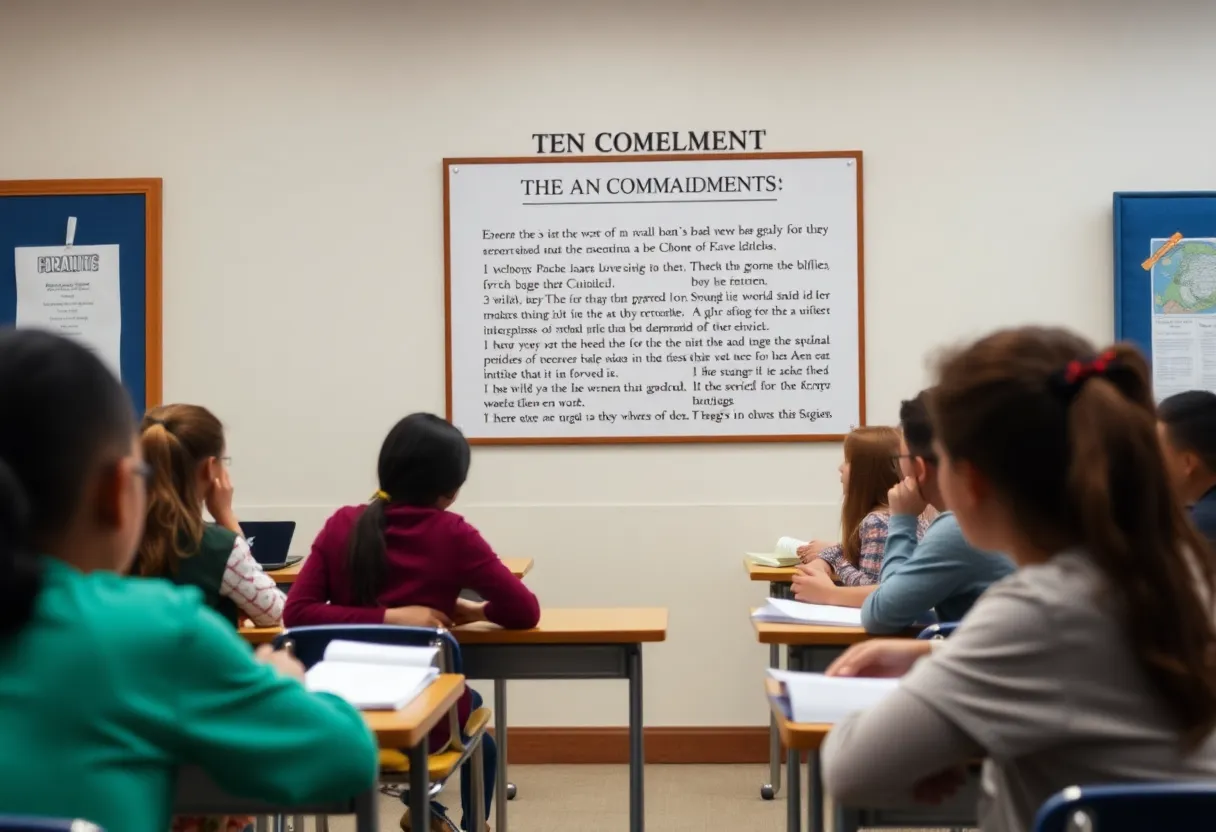
A new law in Texas, Senate Bill 10, requires public schools to display the Ten Commandments in classrooms. This legislation has ignited controversy and legal challenges, with a coalition of families arguing it violates the First Amendment. Critics, including various religious leaders, state that the law imposes one faith’s beliefs on diverse student populations, raising concerns about religious bias. Supporters claim it promotes moral values. The law’s effects on public education and religious freedom are being closely monitored as legal disputes arise.
Austin, Texas – A new law enacted in Texas, known as Senate Bill 10 (SB 10), mandates the display of the Ten Commandments in every public school classroom across the state. This law requires the Commandments to be displayed in a size of at least 16-by-20 inches, using a legible typeface in a “conspicuous place.” Set to take effect on September 1, the law has already sparked significant controversy and legal challenges.
A coalition of 16 families from various religious and nonreligious backgrounds has filed a lawsuit against SB 10, claiming that it violates the First Amendment, which protects against the establishment of religion and ensures the separation of church and state. The legal support for this lawsuit comes from organizations such as the ACLU of Texas, the ACLU, Americans United for Separation of Church and State, and the Freedom From Religion Foundation. These organizations are working together to challenge the constitutionality of the law.
The plaintiffs argue that the mandated display of the Ten Commandments reflects a biased Protestant interpretation that does not fairly represent the beliefs of other faith traditions. For instance, the Jewish version focuses on God’s liberation of the Israelites from Egypt and uses the term “murder” instead of “kill.” In contrast, the Catholic version excludes the prohibition against graven images, aligning with Catholic practices that include religious iconography. These differences highlight the potential for religious exclusion and bias in the law.
Critics of the law, including religious leaders from various faiths, have expressed their concerns. For example, some have pointed out that the law imposes one specific faith’s scripture on all students throughout the school day, thereby infringing upon the beliefs of those who practice different religions or identify as nonreligious. This situation raises serious questions about whether public schools should advocate for specific religious texts when students come from diverse backgrounds.
The sponsors of SB 10 in the Texas Senate have stated that the display of the Ten Commandments promotes religious values and awareness among students. Some advocates believe that such displays can foster moral development and ethical behavior. However, opponents argue that this perspective is a violation of religious freedom principles and may put undue pressure on students to conform to one particular set of beliefs.
The Texas attorney general is tasked with defending the public school system against any lawsuits challenging the legality of these mandated displays. Critics of the law point out that it echoes prior efforts to enforce similar mandates, which have previously been ruled unconstitutional. For example, a 1980 Supreme Court ruling in *Stone v. Graham* determined that public displays of the Ten Commandments serve no legitimate educational purpose and violate the establishment clause of the First Amendment.
In 2022, a Supreme Court ruling in *Kennedy v. Bremerton School District* has been cited by supporters of SB 10 as a justification for questioning established church-state separation precedents. Yet, many activists remain united in opposition, reiterating that the law represents an overreach by the government and threatens the rights and beliefs of students from all backgrounds.
With the potential to impact over 5.5 million students in approximately 9,000 public schools throughout Texas, the implementation of SB 10 remains a contentious issue. Its critics emphasize that the law could undermine the educational environment by prioritizing one set of religious norms over another, contrary to the principles of inclusivity and respect for all beliefs.
The legal challenges ahead will determine whether SB 10 can withstand scrutiny and what implications it may hold for public education and religious observance in Texas schools. As the law’s effective date approaches, a close watch will be maintained by families, educators, and legal experts awaiting the outcomes of this unfolding situation.
Deeper Dive: News & Info About This Topic
HERE Resources
Texas Faces Federal Lawsuit Over Ten Commandments Displays
University of Texas at Austin Achieves Top Ranking in Texas
61-Year-Old Man Arrested for Roommate’s Murder in Austin
ACLU Files Lawsuit Against Texas Ten Commandments Law
University of Texas at Austin Students Protest Visa Policy Changes
Houston Secures Legislative Successes in Latest Texas Session
Texas Mandates Ten Commandments Display in Public Schools
UT Austin Ranked Premier University in Texas
Dallas Coalition Sues to Block Texas Law on Ten Commandments in Schools
Texas Mandates Ten Commandments Display in Classrooms
Additional Resources
- Christian Post
- Wikipedia: Ten Commandments
- AP News
- Google Search: Ten Commandments law Texas
- Al Jazeera